Featured Post

Brad Pitt and Tarantino's Inglourious Basterds and Aldo Ray

Continuing at Huff Po is another small minded review of Inglourious Basterds http://tinyurl.com/nyeqfc (please bear with me until I learn...

Popular Posts

Showing posts with label Bolano. Show all posts

Wednesday, June 19, 2019

The Invisible Man - How Parrhesia Works through Art: The Elusive Role of the Imagination in Truth-Telling Foucault Studies, 2019 Marrigje Paijmans

How Parrhesia Works through Art: The Elusive Role of the Imagination in Truth-Telling
Foucault Studies, 2019

It is no measure of health to be well adjusted to a profoundly sick society. ..Krishnamurti

Creation takes place in choked passages" (G. Deleuze) which means for me there's no passage which is unchoked - hence, any creation for which "passage" is taken for granted (especially the one from 'noise to voice' (The Logic of Sense) cannot be creative at all.


I would say prison is a “choked passage.”

Laboratory of Nano-Fascism:  Although this relationship to death was once thought to belong originally to punk, expressed specifically in the funeral sculptures of Joy Division covers such as Closer and Love Will Tear Us Apart, and PIL’s Death Disco, it has been repurposed by Neanderthal capital in order to zombify the world.

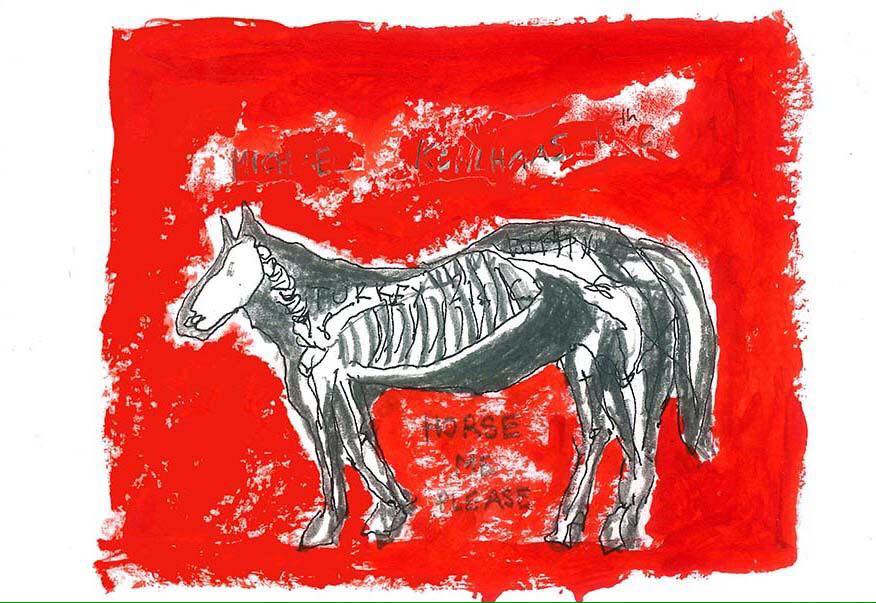


Non Conceptual Negativity  Zafer Aracagök
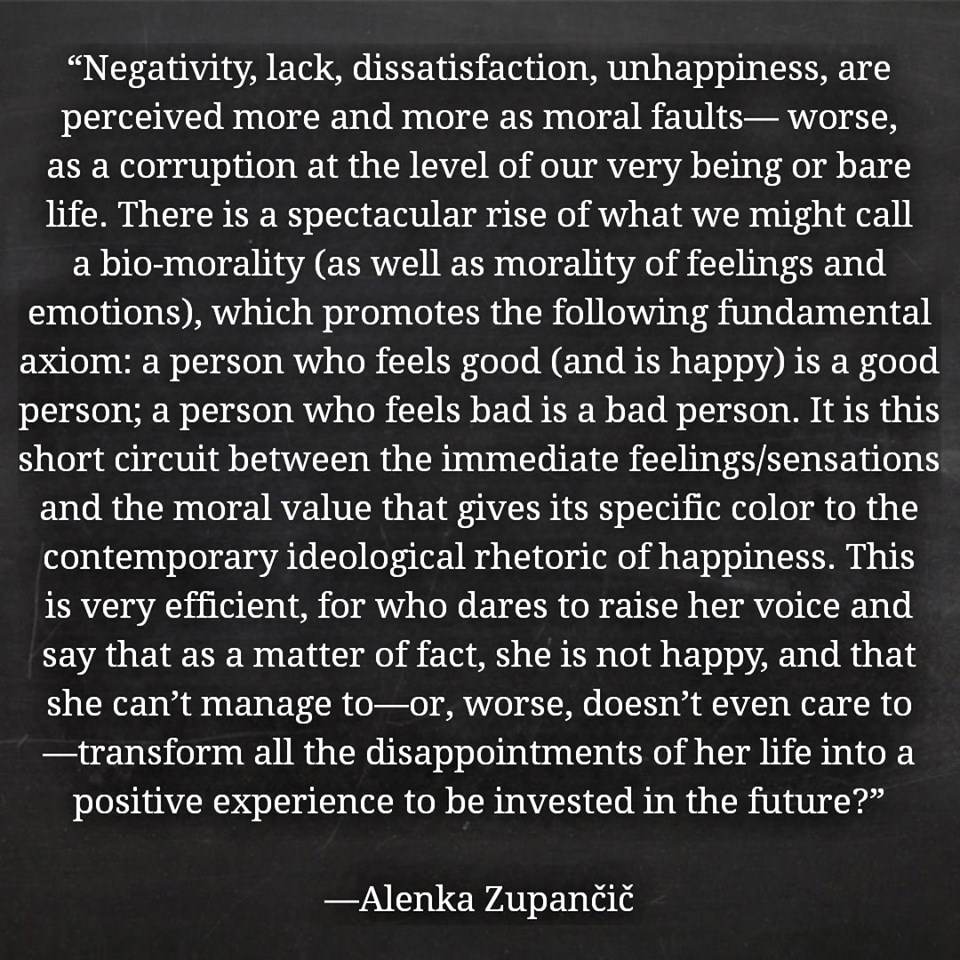


Can we come back to Krishnamurti on this please. " It is no measure of health to be well adjusted to a profoundly sick society." My personal feeling is that if you are not depressed, melancholy or bi polar or schizophrenic you are not paying attention.


This is interesting: “Owen Andree Um, no. The hysterics' *desire* is to continually and question/harangue the Master/authority's position.”

To see the Invisible Man may be to instantly recoil in fear, disgust, horror, side step, turn away from an image covered face to toes with dark prison tattoos. Not a human one wishes to link with.

A live human image that has disintegrated the boundaries, the limits of class, sex, age and race.
AND NON DECORATIVE

An image that is irreplaceable, non-reproducible, non-commodified, non exchangeable or accumulated. You cannot buy it, sell it, hoard it, own it, keep it, display it. A living image that can be destroyed physically, but alive forever in the imaginations of subjects who have allowed themselves to experience the Invisible Man. A digital image existing in Simulated Reality will be as useless as J. Hillis Miller tells you the reading of Heart of Darkness will be if you do not already know it from experience, and if you do you will not need to read it. The image recorded is not to experience the REAL. Only the experience of the real Invisible Man will challenge you with parrhesia, the truth of parrhesia that confronts you in your experience of him. Did it?

Without experiencing the confrontation of parrhesia inherent in his image your imagination cannot transform the work of art that he is, which precludes any change in your mode of being, your lived life, by your experience of him. An image of the human body aligned and defined in great classical beauty resonating with classical Greek sculpture inscribed, desecrated with ugly prison tattoos - some ironically funny and some cliches, but never aesthetic. And so the different levels of episteme through time from ancient Greece to the post modern NOW hit you between the eyes.
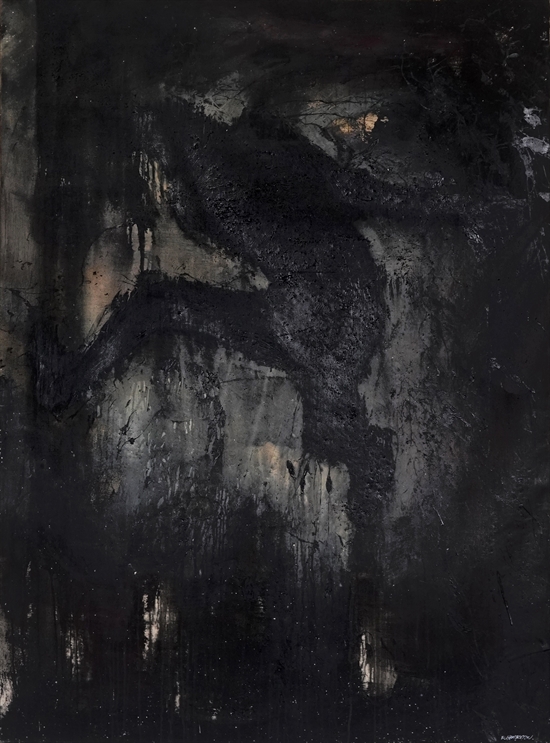
 Richard Hambleton- Jumping Shadow       Fight Club?
Foucault’s genealogical method reveals The Invisible Man’s fusion with other works of art signaling parrhesia and challenging us with confrontation and a demand for change, for transformation of ourselves to a different way of seeing, perceiving and being. Only OTHERNESS can accomplish this. Not different. OTHERNESS.

Velasquez: Las Meninas
Manet: Le Dejeuner sur l’herbe / Luncheon on the Grass
Picasso:Les Demoiselles d'Avignon; Guernica
Warhol:Campbell Soup Cans
Jasper Johns:Flags and Destruction of Abstract Expressionism
Kathy Acker: everything
Herman Melville:Moby Dick:Ishmael and Queequeg
Leslie Fiedler:essays (football et al)
Leo Steinberg: art history and essays
Shakespeare: everything
Banksy: Performance Piece Dismaland;wall murals of political parrhesia
Ai WeiWei: Sculptures
Mark Tansey: everything
Marina Abramovic: Performance Art; The Artist Is Present
Luce Irigaray: Speculum of the Other Woman
Roberto Bolano: 2666
Eugene:The Invisible Man 

Herman Melville: Moby Dick: Ishmael and Queequeg (p. 535)

With a wild whimsiness, he now used his coffin for a seachest: and emptying into his canvas bag of clothes, set them in order there. Many spare hours he spent, in carving the lid  with all manner of grotesque figures and drawings; and it seemed that hereby he was striving, in his rude way, to copy  parts of the twisted tattooing on his body. And this tattooing, had been the work of a departed prophet and seer of his island, who, by those hieroglyphic marks, had written out on his body a complete theory of the heavens and the earth, and a mystical treatise on the art of attaining truth; so that Queequeg in his own proper person was a riddle to unfold; a wondrous work in one volume; but whose mysteries not even himself could read though his own live heart beat against them;and these mysteries were therefore destined in the end to moulder away with the living parchment whereon they were inscribed, and so be unsolved to the last. And this thought it must have been which suggested to Ahab that wild exclamation of his, when one morning turning away from surveying poor Queequeg - "Oh, devilish tantalization of the gods!"

IF YOU CANT BE A WORK OF ART, WEAR A WORK OF ART. - OSCAR WILDE


Genealogy of Body Tattoos - Tamati Waka Nene by Gottfried Lindauer (1839-1926), 1890, oil on canvas, 40”x33”, Auckland Art Gallery, New Zealand. 
Beautiful Face.

“The past is never dead. It's not even past.” - William Faulkner


In Robert Wilson's Opera
The Life and Times
Of Sigmund Freud,
I watched you run
Before you were born.
A Mercury of Time,
Now a running Apollo
Scribbled all over
By drunken Dionysians
With intentions of Parrhesia
You know nothing about.
Seeing you now confuses
The past which was
The future and this present
Mirroring the past.
Is there a tense somewhere
That they call
Future past or past future
Like the Intentional of the Hopi?
Because her car was laden
With Destiny that came
Crashing across my lifeline
Forcing me to live
In Alterity; waving at her
Drifting farther away,
Until I almost can't hear her sigh.

It is not the present which influences the future, thou fool, but the future which forms the present. You have it all backward.  Since the future is set, an unfolding of events which will assure that future is fixed and inevitable. CHILDREN OF DUNE  Leto II p. 278 *

___________________________________________________


They aren’t all prison tattoos 
She screamed at me
On Facebook! 
This one and this one
Were done on the outside.
My brother did the cross
He tattooed over!
There are more prisons 
In this world, Horatio
Than are dreamt of in your philosophy
______________________________________________________

The Aral Sea is the future. Since it exists in the present we fail to recognize that it is only
wearing the mask of the present. It is a Debordian spectacle concealing the REAL forming
the present from the future.A radical piece of the future detached and both visible and invisible.
opens with Lake Michigan mirroring the Aral Sea and surrounding areas, the future in the
fantasy movie image of a present Chicago

Friday, December 07, 2018

666 is the Mark of the BEAST

2666?
666 the MARK of The BEAST.

 And what rough beast, its hour come round at last, 
Slouches towards Bethlehem to be born?  

William Butler Yeats

Bethlehem is in Palestine. The BEAST is there. 
Is Israel the BEAST being born?

CTHULHU?


666 x 4 = 2664 WHICH IS ALMOST 2666 eh so let's round it off

Bolano has doubled 666 and redoubled  giving us the TITLE so much in controversy as to its meaning right now. The Critics and Reviewers are stressed out over this date.

When 666 is tripled then 1998 is the result when Bolano is working against death to finish 2666.
They cannot kill him for this expose because he will be/is dead.
  

Doubled and redoubled is a term Irigaray often uses. Did Bolano read her? I am guessing no but it's just a guess. It could go either way.

THE BOOK FOR WOMEN TO KNOW WELL
Without it you are half asleep. Maybe even more.

2666 is divided into 5 sections.

1. The Part About The Critics.
2. The Part About Amalfitano
3. The Part About Fate
4. The Part About The Crimes
5. The Part About Archimboldi

5 is a Prime Number

PRIME 

PRIMO FIRST PREMIER MOST IMPORTANT .......

Klaus Haas- "No one pays attention to these killings, but the secret of the world is hidden in them." (p. 348)

IN ONE OF HIS MANY NOTES FOR 2666, BOLANO INDICATES THE EXISTENCE IN THE

 WORK OF A "HIDDEN CENTER," CONCEALED BENEATH WHAT MIGHT BE


 CONSIDERED THE NOVEL'S "PHYSICAL CENTER." THERE IS REASON TO THINK THAT


 THIS PHYSICAL CENTER IS THE CITY OF SANTA TERESA, FAITHFUL REFLECTION OF


 CUIDAD JUAREZ, ON THE MEXICAN-US BORDER. THERE THE FIVE PARTS OF THE


 NOVEL ULTIMATELY CONVERGE; THERE THE CRIMES ARE COMMITTED THAT


 COMPRISE ITS SPECTACULAR BACKDROP (AND THAT ARE SAID BY ONE OF THE


 NOVEL'S CHARACTERS TO CONTAIN "THE SECRET OF THE WORLD"


T.S. Eliot in Sweeney Agonistes:

Any man has to, needs to, wants to
Once in a lifetime, do a girl in.

The "Gravitational Law" of 1666 (Newton) is pulling inexorably toward the center of the world.
The Secret of the World The Crimes are telling us?

What is that SECRET?

The SECRET is the PRIME SECRET of Our World.
Forget about the rest of the baggage.

That is what Irigaray is telling us and Bolano is graphically illustrating for us in fiction.

The mirroring? Is the mirror convex? Maybe it is concave? Maybe two mirrors facing each other where you are not in either one of them when you stand between them?
Plato's Cave is coming UNDONE!

The SECRET of 2666 is revealed by Irigaray

Irigaray's convoluted deconstruction of Freud and Plato is told in fiction by Bolano. Now we can't complain that we don't understand because Irigaray is too difficult for us to read.
Bolano makes her crystal clear.


Bolano indicates the existence in the work of a "hidden center," concealed beneath what might be considered the novel's "physical center." There is reason to think that this physical center is the city of Santa Teresa, faithful reflection of Ciudad Juarez, on the Mexican-U.S. border. 

There the five parts of the novel ultimately converge; there the crimes are committed that comprise its spectacular backdrop (and that are said by one of the novel's characters to contain "the secret of the world"). As for the "hidden center"...might it not represent 2666 itself, the date upon which the whole novel rests? (p.896)

No the hidden center is not the number 2666 in my reading of 2666.

Friday, November 30, 2018

BOLANO 2666 My Reading of the Number

Words Written in Blood should not be read but learnt by HEART.- NIETZSCHE

Everyone reviewing this book bores me. As Bolano has said writing is like being a detective and reading is being a detective.

2666

666 is the MARK of The BEAST.
 And what rough beast, its hour come round at last, 
Slouches towards Bethlehem to be born? - Yeats


Newton's Law of Gravitation came to him about 1666, when he was twenty-four. ...in those days I was in the prime of my age for invention, and minded mathematics and philosophy more than at any time since.

Bolano planned his great masterpiece for awhile before he wrote it.  2666 was being finished up when Bolano was forty-eight, just double Newton's age and 1000 years later as a date. Bolano was dying and died just before finishing it but the book we have is just about exactly the way he indicated it be finished. 

2666 - 1666 = 1000 a nice number eh.

2666 divided by 2 = 1333 a prime number which is nice but not serious. 


A REAL Mathematician writing about REAL mathematics


And this is where I happened to find the Newton quote. IMO this is what Bolano means by being a reading detective. The problem with the date exists in all reviews. So I had stored the problem in my head and here I found my reading without searching. Also on pages 64-65 Hardy compares his essay as trying to do for Mathematics what Bradley did in an incredibly long and complex book, which is one of two reasons I bought the book. Actually the third reason is that I have a "bank account" at my favorite local bookstore BOOKMARX in SpringfieldMO. 


Appearances in Bolano talk are SEMBLANCES about which he has much to say

Bradley was the great influence on T.S. Eliot when he was a philosophy student at Cambridge. Hardy was there also.

The Wasteland
Prufrock

The Cocktail Party
When two people who know they do not understand each other
Breed children whom they do not understand
And who will never understand them.

Can we just say there is no love.

Since Bolano was a poet most of his life and turned to fiction after he was married and to leave an inheritance to his family, we know for sure he knew Eliot the great poet of the twentieth century. So surely Bolano also knew F. H. Bradley as his primary influence and we pick this up in all the inclusions of SEMBLANCES Bolano discusses for us. That is, the world is composed of appearances, of semblances. One tears away the veil of appearance - semblance - and the next layer of appearance appears, and so on.

Exceptional edition I chose because Wyndham Lewis writes an essay on Eliot. He was a great influence on Marshall McLuhan and I have been waiting for the universe to present me with his writing somewhere, sometime, and it appeared so that is how I got to Bradley and was pleased that Hardy revered him also. He has been lost in the folds of philosophy where another Foucauldian wants to dig him out. 

Extra also in this collection and another McLuhan influence I. A. Richards with another wonderful essay to match Lewis's one. This book with a portrait of Eliot.

Not as good IMO but a portrait of Eliot by Wyndham Lewis on the cover.  Peter Ackroyd editor.


So I was just out of this detective play when I started 2666. I have a default in my mind on Foucault and anything else I am wondering about.  I only read Hardy after Bolano for the math part and was astonished. Bolano playing with Newton and himself. One young, one dying young captured by imagination. Is this true? I have no idea but I like it and I bet Bolano would have been charmed.


Bolano likes playing with numbers: 

The book was Rafael Dieste's Testamento geometrico published in 1975. (One copy at Amazon for just under $1000!) Amalfitano will take clothespins, hang it on his clothesline in his backyard to turn it into a Duchamp of his own. It is divided into three parts: On the front flap , the reader was informed that the Testamento geometrico was really three books, "each independent, but functionally correlated by the sweep of the whole," and then it said "this work representing the final distillation of Dieste's reflections and research on Space, the notion of which is involved in any methodical discussion of the fundamentals of Geometry." At that moment, Amalfitano thought he remembered that Rafael Dieste was a poet.

This time the advance he sent Archimboldi was bigger than any previous advance, in fact so large that Martha, the secretary, before mailing the check to Cologne, brought it into Mr. Bubis's office and asked (not once but twice) whether the sum was correct, to which Mr. Bubis answered yes, it was, or it wasn't, what did it matter, a sum, he thought when he was alone again, is always approximate, there is no such thing as a correct sum, only the Nazis and teachers of elementary mathematics believed in correct sums, only sectarians, madmen, tax collectors (God rot them), numerologists who read one's fortune for next to nothing believed in correct sums. Scientists, meanwhile, knew that all numbers were only approximate. Great physicists, great mathematicians,  great chemists, and publishers knew that one was always feeling one's way in the dark.(p. 823)

...Archimboldi told her he was looking for literary publishing houses that were still active. The librarian said she could help. For while she rummaged through some papers and then she made a phone call. When this was done she handed Archimboldi a list of twenty publishing houses, the same as the number of days he'd spent typing his novel, which was surely a good sign. (p. 792)

All the critics and reviewers cite 2666 from this passage in Amulet:

I followed them: I saw them go down Bucareli to Reforma with a spring in their step and then cross Reforma without waiting for the lights to change, their long hair blowing in the excess wind that funnels down Reforma at that hour of the night, turning it into a transparent tube or an elongated lung exhaling the city's imaginary breath. Then we walked down the Avenida Guerrero; they weren't stepping so lightly any more, and I wasn't feeling too enthusiastic either. Guerrero, at that time of night, is more like a cemetery than an avenue, not a cemetery in 1974 or in 1968, or 1975, but a cemetery in the year 2666, a forgotten cemetery under the eyelid of a corpse or an unborn child, bathed in the dispassionate fluids of an eye that tried so hard to forget one particular thing that it ended up forgetting everything else. (p.897)

What a sad paradox, thought Amalfitano. Now even bookish pharmacists are afraid to take on the great, imperfect, torrential works, books that blaze paths into the unknown. ...but they have no interest in real combat, when the great masters struggle against that something, that something that terrifies us all, that something that cows us and spurs us on, amid blood and moral wounds and stench. (p.896)


And then there is the title. That enigmatic number, 2666-a date, really - that functions as a vanishing point around which the different parts of the novel fall into place. Without this vanishing point, the perspective of the whole would be lopsided, incomplete, suspended in nothingness. (p. 896)


The Gravitational Law pulls The Crimes underneath towards the Center of the World. Towards the VOID that can never be filled. 
Toward WOMAN.

You have to listen to women. You should never ignore a woman's fears.(p. 348)


Bolano indicates the existence in the work of a "hidden center," concealed beneath what might be considered the novel's "physical center." There is reason to think that this physical center is the city of Santa Teresa, faithful reflection of Ciudad Juarez, on the Mexican-U.S. border. There the five parts of the novel ultimately converge; there the crimes are committed that comprise its spectacular backdrop (and that are said by one of the novel's characters to contain "the secret of the world"). As for the "hidden center"...might it not represent 2666 itself, the date upon which the whole novel rests? (p.896)

The forgotten cemetery is the forgotten gardens in the last pages where the descendant of Furst Pukler tells Archimboldi his story?


Thursday, March 01, 2018

REVIEW: RECKLESS DAUGHTER A PORTRAIT OF JONI MITCHELL BY DAVID YAFFE


David Yaffe has written an exceptional biography of Joni Mitchell. His genius in telling her life and music lies in 


what he doesn't say!

Yaffe resists interpretation. He obviously interviewed with her and recorded what she said. And he did the same with other celebrities who knew her. Yaffe is also right on top of her music, the music of the scene around her and her position in it. He easily acknowledges her genius, her open tuning which she invented accompanied by her memorable voice. And this is where he excels in praise of her.

I spent an afternoon with her and Joy Schrieber - Joy Fibben - the manager of The Second Fret that showcased Joni before she was famous. A little dive on Sansom Street in Philadelphia, kind of dark and funky. This is where I saw her as I knew Joy and her husband. It was October of 1967 when Joni performed there when I first saw and heard her.

That afternoon she came into the area in Joy's apartment where we were talking, sat down and began to continue to write a song. Quietly, not greeting me at all, just Joy. She showed Joy some little beaded purses she had bought and Joy said, "Joni likes little purses."

I left soon after and saw her perform that evening. In performance she was mesmerizing, seductive and wonderful, promising everything. I knew she would be great immediately. A few nights later I took a lawyer friend to hear her. He was critical of her and said he thought she'll never make it. I said, "Oh yes she will." And I couldn't understand why he thought that. Perhaps it was her waif like appearance. Now I know she cultivated that until the trends changed.

Her bout with polio and her long stay in the hospital is described. This I never knew. Her parents visited her only ONCE! She was expected to be paralyzed, in an iron lung for the rest of her life. But she decided she wasn't going to be and struggled to move and then walk again.

Yaffe says only this about that time. He does not interpret it. I will though. I was utterly chilled by the fact her parents simply gave her up at a terrible time in which to withdraw all emotional support. It is no wonder her relation to her parents became indifferent after that. She must have come to terms with this then, the fact that she could never expect anything from them again. Invert this: nor did she owe them anything after this. She was free. Alone but free. With only herself to depend on. 

I am thinking at this time a great deal of Walter Richard Sickert whom I am convinced was Jack the Ripper. But another time for that. 

Joni made a deal with God. If I can walk again I will pay this back to you. She recognizes the gift and the indebtedness the gift imposes. The counter-gift. And she delivers. 

Sickert made no deal. And he was not yet 5 years old. And in agonizing pain and terror.

Yaffe is aware that she was the singer songwriter of loss. She spoke to those in pain. She knew about that. But her music was the only place, it seems, that she owned it, preferring to deny all this in her life and relationships.


… Don't it always seem to go 

That you don't know what you've got 
'Till it's gone 
They paved paradise… More


The Unsung Poet of Loss


Yaffe quotes Elizabeth Bishop on loss

The art of losing isn't hard to master; so many things seem filled with the intent to be lost that their loss is no disaster

This is a poem in response to the great Catherine Breese Davis's great poem: A villanelle and her best known poem. A reply to Dylan Thomas's Do Not go Gentle and certainly resonates with Bob Dylan's 
"Nothin left to lose"


After a time, all losses are the same,
One more thing lost is one thing less to lose;
And we go stripped at last the way we came.
............................................................................

So we, who would go raging, will go tame
When what we have we can no longer use;
After a time, all losses are the same
And we go stripped at last the way we came.

Davis's life was composed of losses too terrible to list. Her life was simply horrifying and she was still able to leave us some of the greatest poetry of her time. 

Perry Meisel reviews Hejira thus:

 Hejira presents the Queen of El Lay (referring to a Rolling Stone diss) more explicitly in the guise of a poet than ever before, festooned with cape, beret, slanted pinky, and the backdrop of a resolutely abstract landscape. Well, that's the way poets are supposed to look, I guess, and Mitchell's (self-) portrait here seems to be a little too aware of that.  

He continues but let's not here. This is nasty and yet very true when one stands her lyrics beside a master. Meisel does not understand the oncoming of Simulated Reality when stating one is a poet in IMAGE amounts to CREDIBILITY. The image obscures the real.

Here is an image by Mark Tansey that says it 
Mark Tansey the Picasso of the 21st Century
Mitchell just posits herself as an image of poet and voila she is a poet to her masses of fans. As Bolano saying that mediocre is necessary to see the diamond in the pile. (Something like that.)

Meisel hasn't become aware of this yet but Mitchell has.

Yaffe details with interview quotes from the wonderful and generous Judy Collins who used her clout at Newport to feature Mitchell and Dylan and shine the light of excellence on them. For this wonderful act of generosity and good will Collins received only sniping from Mitchell as she didn't like Collins interpretation of Both Sides Now which Collins had made famous by singing it on her recent album. 

Obviously Mitchell never understood that one's reading (interpretation) of a song "is that person's reading," that there is NO ABSOLUTE READING. Of course Collins would read the song differently from Mitchell or anyone else. And Collins was hurt by her lack of appreciation for the great gift she gave Mitchell in headlining her at Newport.

And this brings us to "The Gift." As Ainslee Meares says it:

Meares travels in the far east searching for new ways to cure old illnesses.
We have all read countless accounts of these travels. Meares gives us such a clear perception we can only be grateful to have all the ideology and PR wiped away.

Giving and receiving. What problems arise from this simple process! It may be hard to give, and I am sure it often is. But it is harder to receive, of this I have no doubt at all. I have seen too many patients tense and disturbed because they could not receive without anger. Once might expect people to be pleased and thankful at being given something. But look around, and you will see how often it has the reverse effect.And it is not difficult to see why this should be so. Giving places the receiver in your debt. No wonder he is resentful. But there is more to it than that. As babies our mothers gave us their milk freely, and we were happy to receive it. When we were children, our parents gave and we received. This is a law of nature. It is set in our mind that grown-ups give and children receive. Then as adults we are given something. Unconsciously it makes us feel as children again....

Nietzsche deconstructs the GIFT in his Genealogy of Morals which parallels the far east thinking detailed by Meares.
If you haven't read Nietzsche it is past time.
Mitchell will finally acknowledge her daughter publicly. She has finally received the long awaited call from her daughter. The one she gave up right after birth to a foster mother, then permanently and legally surrendered 6 months later. Here is what Yaffe says:


Joni held the baby... And then Joni signed the surrender papers. There was a form in the baby's adoption files called "Non-Identifying Background Information." Without revealing either parent's name, there were details left for the baby: that her father had been above average height, that her mother had once had polio and grew up in Saskatchewan, and this telling line:"Mother left Canada for U. S. to pursue career as folksinger."

So cold that last line.

After the honeymoon reunion her daughter vented her anger at being given up. This is natural but Mitchell became estranged. That terrible last line. Gave me up to become a folksinger. How wounding.

Fans and others will read this biography and a portrait will emerge of Mitchell with her adoration of fans muted by age and experience. We cannot know how desperately she had to defend herself and her vulnerability in her life that is bare in her music and lyrics. It is not for any of us to judge. But I do cringe at some of this, but that is just my own personal baggage. Not hers.